
Trash Bins in the Bike Lanes!?
The Problem
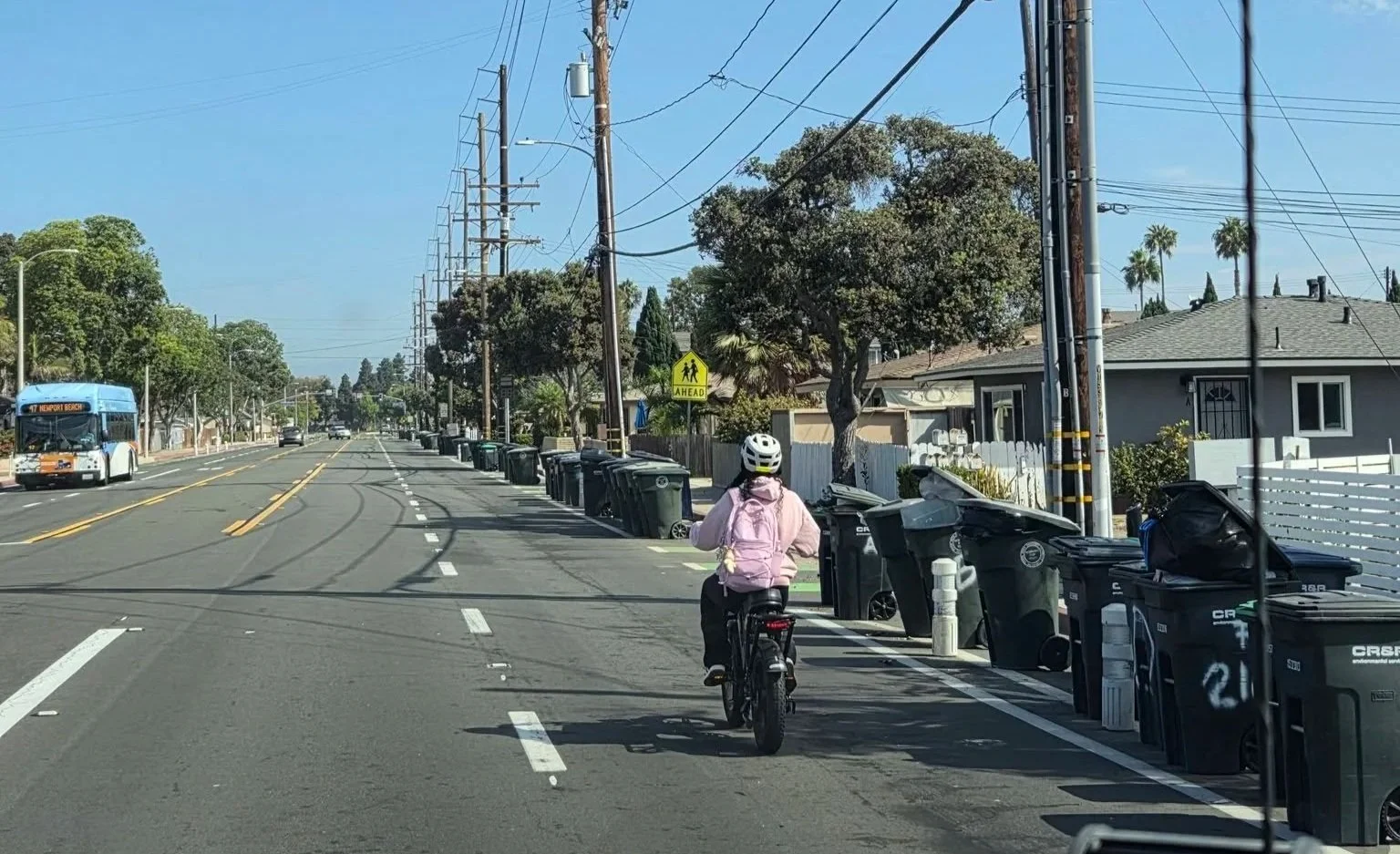
The picture that made its rounds on social media last week (above) is something you may have noticed in real life on Placentia Ave.—trash bins and bike lanes are competing for the same space! This sort of image presents an easy opportunity to accuse Costa Mesa leadership of incompetence or worse. Bike lanes conflicting with essential city services like waste disposal is not a great look. But let’s step back.
What the City Had to Work With
Placentia Ave. has long been a pretty intense street, despite the fact that it is fronted by homes and businesses and hosts Wilson Elementary and Estancia High School, all of which are regularly accessed by people on foot and bike.
Interestingly, the east side of the street between W. 19th St. and Hamilton St. has an alley; the rest of the street, unfortunately, does not. Alleys are a useful urban design tool because they give waste, utilities, and other back-of-house functions somewhere to go without conflicting with the aesthetic and functional purposes of the street frontage. Additionally, they can remove the need for a continuous center turn lane, since front driveways are not needed. They do, however, require more space and therefore more infrastructure and maintenance, which is why they may have been omitted when the land was platted, sold, and developed.
But the part of the street with an alley is not the only stretch without trash bin issues. Curbside pickup is also not needed north of the Joann Trail or for any site where trucks can pull in and access dumpsters in the rear. This leaves a relatively small stretch of the street problematic: the east side between Victoria St. and the Joann Trail, where there are many apartment buildings without adequate on-site truck access. This 2,000-foot stretch is bad on trash days, but functions as part of a largely clear, three-mile bike route for the rest of the week.
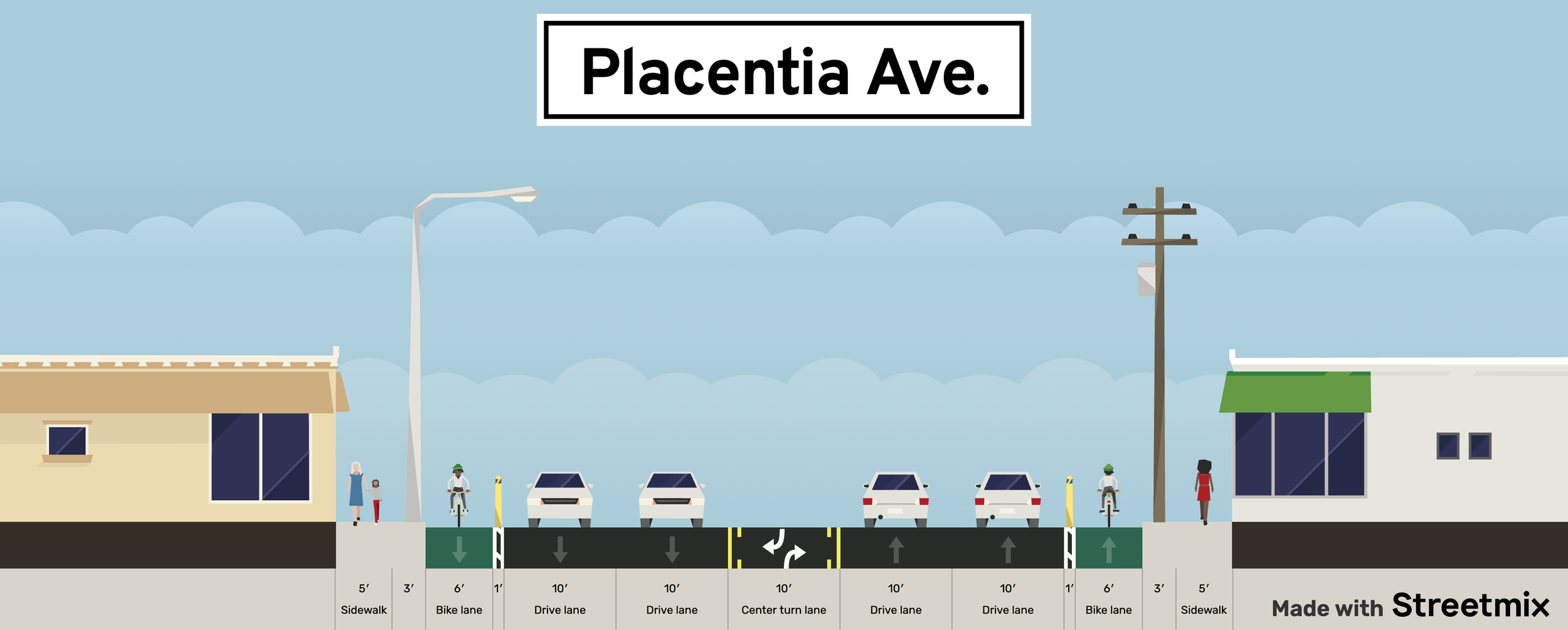
Like every other street, there is only so much space to work with. At Governor St. (where the above picture was taken), the allocation of right-of-way looks something like this.
The Bike Improvements
Given that 1) people do use Placentia Ave. on bikes, and 2) the posted speed limit is 35 mph (down from 40!), the city made the decision to extend bike lanes to the whole street, add modest buffers, and provide plastic posts to make biking a bit more comfortable.
And if you or a loved one used that bike lane, you wouldn’t want the lane to suddenly end for 2,000 feet because of a weekly trash day conflict. So there is a bit of unfortunate messiness, but bike lane users likely deem that messiness preferable to having no protection on Placentia Ave at all.
So What Should the City Do?
We want to simply provide some context so we can think about the problem more clearly—not defend the design or suggest that it’s fine as it is. Removing the bike lane might seem like an easy way to eliminate the conflict, but it would create problems of its own. Giving that space back to cars could increase traffic speeds and would make bicycling substantially less comfortable, while shifting more trips toward driving can add to congestion and create pressure for still more roadway space. And the cycle continues. It would also result in other things that people probably won’t like, such as students riding to Estancia in traffic lanes or local bicyclists choosing the sidewalk instead of the street.
The bike lane buffer is the most obvious place to accommodate the bins, so widening it just a bit seems like the simplest change. But where would we find the space? As you can see in the graphic above, there really isn’t much to work with after providing four travel lanes plus a center turn lane for cars. Moving curbs or utility poles would be prohibitively expensive.
Conclusion
We’ll say just these few things:
The community’s reaction to ugliness is evidence that there is a general expectation for beauty in the public realm, and we couldn’t agree more.
We should acknowledge that most of the right-of-way here remains devoted to motor-vehicle movement, with pedestrians, bicyclists, and other non-drivers sharing the rest, among the utility poles and equipment, tree wells, gutters, and driveway aprons.
Comfort and connectivity influence whether people are willing to use bike lanes, and this principle is important to keep in mind here.
At the end of the day, we would say that while the larger improvement is worthwhile, this weekly conflict is real and should not be passively accepted or tolerated simply because the alternatives are difficult. A next step might be to test whether the buffer can be widened along this stretch, and possibly to develop a clear trash-day arrangement with residents and the waste removal service, if no intentional arrangement has yet been made.
We believe that good street design is iterative; acknowledging a flaw is not an argument for abandoning the project, but for finishing the work.
